Tuesday, April 05, 2011

Twilight in Tokyo


Tokyo received little direct damage from the March 11 earthquake and tsunami. Suburban areas, particularly Chiba seem to have been more directly affected. Rolling blackouts continue in the suburbs of the city, but the central part of Tokyo remains largely unaffected by these. Subways and trains in the city center are back nearly to their pre-earthquake schedules. 

Because so much of the Tokyo Electric Company’s (Tepco) generating capacity is offline, power shortages and the rolling blackouts are likely to continue for weeks, or more probably months. Train stations, department stores, grocery stores and other large retailers are keeping their lights dimmed, with their outdoor signs mostly off. The reduced hours many have kept for the past couple of weeks are inching back to their normal operating hours. Mom and pop restaurants have begun turning their signs back on at night. Whether the lessons of excessive power consumption have truly been learned is yet to be seen. 

There have been stories in the foreign press about the self-restraint that has taken hold in Japan. That is true to an extent. But the crowds in Shibuya on March 18th did not appear any smaller for the lack of giant, blaring advertisements that usually light the main crossing there. The screeches that are supposedly singing coming from local karaoke bars in the wee hours of a weeknight would indicate not everyone has taken up this outlook. The lights may be down, but aisles of electronics retailers and bookstores have not seemed much off their typical size.

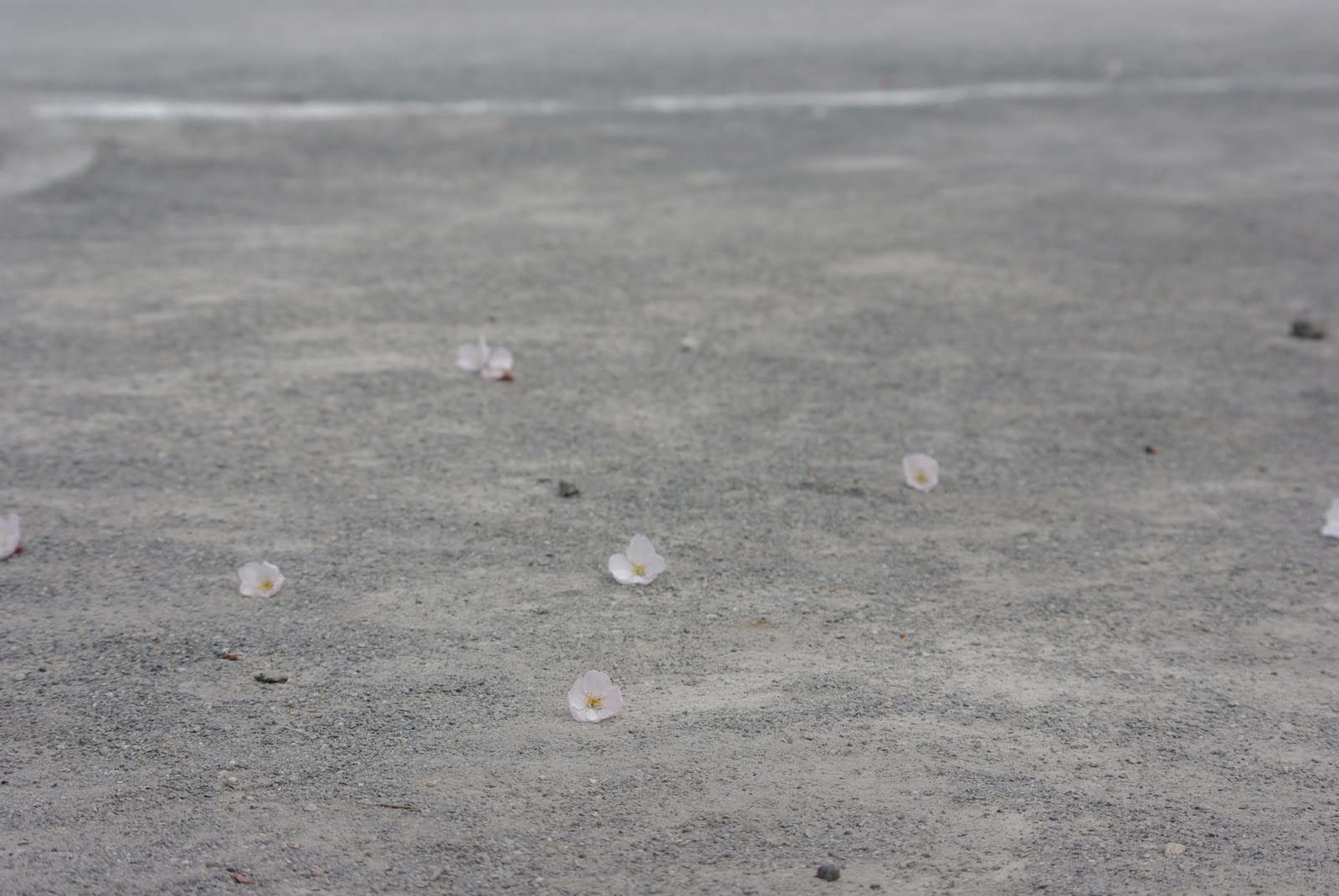
Restraint certainly has been encouraged by Tokyo’s governor and even local governments. This is traditionally the time of year when Japanese hold hanami parties, picnicking under the cherry blossoms in the parks. Signs have been erected by the Tokyo municipal government discouraging such behavior this year. In the idle monkey trainer’s neighborhood city officials (or their volunteer minions) distributed leaflets and politely asked those partaking in such parties – particularly those with alcohol – to show restraint. They even implied that those not showing restraint would be asked to stop drinking. Rather than revel in the new spring as usual, everyone is being told it is more appropriate to be mourning the victims to the north. These reflect the attitude of Governor Ishihara, who has had to retract his own remarks about the disasters being divine punishment for Japan’s ego and greed. (Sadly, such thoughts and statements probably will not prevent him from winning another term as governor in Sunday’s election.)

And despite the perfect weather for hanami this past Saturday, the park did seem a bit quieter than in years past. Perhaps there was less alcohol and food consumed. Maybe there was even a bit more reflection on the transcendence of life as witnessed in the fleeting beauty of the cherry blossoms – or cherry jello shots.
Monday, March 14, 2011

March 11 - 14, 2011

Just after 2:oo p.m. on a lovely early spring afternoon the shaking started. At first it seemed to be no more than the usual rocking, which is viewed with general nonchalance by the majority of residents. Then it kept going, and growing stronger. Concern began to creep into voiced thoughts. “Is it time to get under the desk?” “No. It’s better to get out.”

Outside the office building we stood on a narrow strip of road, feeling it sway beneath our feet like the deck of a ship at sea. Overhead we watched power lines sway and dance. The rocking lasted for several minutes, or at least what seemed to be several minutes. As it calmed the adrenalin kept coursing, creating uncertainty as to whether it was our bodies or the earth that was still shaking and swaying.

Aftershocks of various magnitudes followed quickly and frequently. On the eastern horizon plumes of black smoke stretched skyward. Phone service – both land and mobile – halted. SMS texts did not go through. We all turned to the internet, sending out flurries of e-mails and Facebook posts to keep in touch, to find out if friends and family were okay. The trains ceased running.

As evening rolled around and lesser tremors kept rolling, those with housing or places to stay within walking distance – a phrase that took on an expanded meaning – began their treks home. Power, fortunately, was still on. My own journey from my office took my largely against the flow of human (and vehicle) traffic. On the main thoroughfares cars waited patiently in unmoving lines. Throngs of people moved down the sidewalks. There was no shoving, no shouting. There was, as I have seen aptly described elsewhere, a melancholy calm in the crowds. A few people wore helmets, likely company provided. More often, the helmets were carried, in hand should the ground start moving again.

Convenience store shelves were stripped bare of instant foods – cup noodles, mostly – and ready to eat meals, rice balls and sandwiches by orderly lines of customers. By the next afternoon most grocery store shelves followed suit. Staples have become hard to come by. Water, milk, eggs, rice, batteries are in short supply.

Aftershocks continued through Friday night, waking people up on Saturday morning and keeping us up through Saturday night into Sunday morning. Another at about 10:00 a.m. Monday shook long enough to be eerily like the one that started it all Friday afternoon.

Images of the damage caused by the massive tsunamis that came ashore in Miyagi dominated the television, with focus shifting Saturday afternoon to exploding nuclear facilities.

Restaurants, bars and retailers opened more of less normally on Saturday, though without the normal Saturday trade. A few subway lines began running late Friday evening, others opened only again on Saturday with limited service. Ueno Park was quiet Saturday, but near brimming on the warm Sunday afternoon, as people looked more relaxed, walking around the lake, laughing, renting paddle boats, snacking from the usual food stands, watching seagulls try to steal food from a duck.

Most of the damage in the Tokyo metro area seems to be in the eastern part in Chiba, or at least the heaviest seems to be there. A refinery burned Friday. Disneyland is said to be closed for the week while they deal with a busted up parking lot and minor flooding. A friend reported taking a 20km hike Friday night back to his sodden neighborhood. In my neighborhood I saw only minor damage, including to a shrine in Ueno Park. A friend has said that his local grocery store is closed because of a damaged wall.

Monday morning train services were still limited as people started going back to work. Services will be spotty for a while as the Tokyo electric company proposes rolling blackouts be used to compensate for so many power generators being offline. The blackouts, however, have been put off for the time being as consumption has remained lower than expected. Some lines have not opened or have opened only for the morning and even rushes.

Decent information is hard to come by, in English anyway. In Japanese it is better since it can be taken straight from the source. CNN and BBC have the most dramatic aspects, but little else of use. The US embassy is sending out fairly regular warden messages with information and links to primary sources. Japanese television has kept near 24-hour coverage on all channels, with the exception of one that was at least for a while showing beautiful nature scenes from around the world and then a weight-loss program. Facebook, though it proved extremely useful in connecting with people can quickly become a source of incomplete or incorrect information. 

Sunday, October 24, 2010

Shanghai World Expo

On a roasting hot September afternoon, the idle monkey trainer and a colleague grabbed a taxi for the nearest World Expo entrance, where we had to open our bags, then board an Expo bus for the 2-minute journey to the gates, where we had to go through airport-style security.

China

Once inside, it was immediately clear that we would not be visiting a lot of the pavilions. The line in front of the Japanese pavilion, a big pink building that resembled a pig for some reason, confirmed the rumors we’d heard; namely that waiting times wandered into multiple hours. Helpfully, there are digital signs around the Expo letting you know which pavilions are experiencing the longest waiting times. Inevitably China, Japan and the USA were pushing between four- and five-hour waits all day. The signs would also let you know of the shorter (less than an-hour-wait) lines at certain pavilions.

Since I have an aversion to waiting in any sort of line whatsoever, I was fully prepared to take the advice of a helpful website and skip the pavilions for their bars. (This also coincided nicely with my love of trying new beers.) 

We quickly put the system to the test, grabbing a quick bite of skewered meat from the Pakistan pavilion restaurant. 


This was followed up with a stop into the Australian restaurant and gift shop for a Crown Lager and a cheesy, crowd-pleasing overhead acrobatic show with a couple dressed as SCUBA divers. 

Back out in the heat and sunshine it did not take us long to find that Malta had a nice little café and a good beer. At this point, the idle monkey trainer was approached by the first of several locals who wanted pictures taken with a white guy. I should have charged – it could have offset the costs of the beer.

As we exited Malta’s air-conditioned café, we saw that there was no line at the pavilion across the way, and decided we had to hit up at least one. Albania’s pavilion was a single room with a few murals showing beautiful views, and a gift shop that was exactly one display case long. They also had a wishing fountain. Happy that we had made a pavilion, we headed back out into the heat. As luck would have it, Georgia also had no line, so we got a second pavilion marked off. The Georgians used their one-room space to heavily promote their wine and skiing.

As we walked on, Peru beckoned with their strategically placed sidewalk café. A good beer and a meat pie later, we were off again, heading toward Brazil and the promise of a good cocktail. Sadly, AB InBev had the concession and were offering up only local favorites Budweiser and Corona. The same was true for the USA pavilion opposite. Nevermind, we thought, and headed out toward South Africa, via Argentina, who had a gorgeous restaurant in order to promote their own wines.


Not seeing what we were after at South Africa we instead headed into the African pavilion for a quick trip around the continent and rows of market stalls. Also, plenty of stuffed Gorillas.


But no beverages and we were getting thirsty. We headed back to the more reliably imbibing nations of Europe, where Germany’s outside stage was quiet and the bar area boisterous.  Hofbrau Dark hit the spot, but tired of standing room only, we launched out for the Netherlands' Happy Street, fake grass, canals and sheep. 


Naturally, Heineken was king here, so it was a quick one and off again. 


Belgium, we thought, would provide a good brew and bar. Remarkably, we had to actually walk all around the building to the back side to find a concession with beer. 


This proved to work out well, however, since as we sat street-side with our beers, we could watch the Latvians sky-diving simulating pavilion closing show.

Feeling pretty good, if a bit tired, we decided to walk through the rather depressing halls of the Red Cross & Red Crescent Socities’ pavilion. From there it was a short walk to the tropical islands and wooden canoes of the South Pacific nations, before a final pavilion in the form of Indonesia, which despite three-hour waits during the heat of the day was remarkably open and easy to enter after dark, in spite of the live band playing at the entrance. (China and Japan still had long lines as we made for the exit.)

Thursday, October 21, 2010

Let's Dance!

The Asakusa area of Tokyo is normally associated with “traditional” Japan. It was the Ginza before Ginza came up. It was the Edo-era nightlife district. It’s still strongly associated with festivals like the Sanja Matsuri (one of the three largest festivals in Japan). Yet, for some reason, for the last 30 years it has been home to the Asakusa Samba Festival.


Each August, samba teams – some led by Brazilian, but mainly comprised of Japanese dancers – take over two large streets to parade their floats, dancers and corporate sponsors for the throngs who crowd onto the small sidewalks. (The throngs, incidentally, are made up primarily of men in their late 40’s or older with long telephoto lens-equipped cameras.)

Participating teams obviously spend a great deal of time on the design and construction of their floats and costumes. Some are obviously beholden to (or perhaps employed by) corporate sponsors such as Asahi Beer (a major sponsor of anything that happens in Asakusa given their head office sits across the river) and Pocari Sweat.


Other teams’ concepts were harder to guess the relationship to anything samba/Brazilian. For instance, the Cleopatra dancers (though they must be given credit for sticking close to the theme and being the only team to have “slaves” pushing their float rather than using a truck).


And, this one, which the idle monkey trainer cannot even fathom a guess as to its meaning.

The Asakusa Samba Festival is held the last weekend of August.
(And, now, because they would eventually be requested by the readership, here are a couple more shots.)


Monday, October 18, 2010

Hossosawa Waterfall

In the western end of Tokyo’s administrative district lies Hinohara Village – the last “village” in Tokyo. Generally the term village in Japan is reserved for small communities. Despite having exceeded the generally accepted population of a village some time ago, Hinohara has kept the designation, doubtless for marketing purposes. That said, Hinohara looks like no other part of Tokyo – more of a small town nestled in the foothills.

One of the attractions of Hinohara, and the Okutama region to which it belongs, is the Hossawa Waterfall. 


Not the biggest waterfall by any means, it is situated in a lush box canyon at the end of an easy and short trail. From the bus stop or parking lot, make your way past the craft store, ice cream shop, a van selling Potato Burgers and another craft shop, then follow the rest of the trail along the stream with all the other people. Although it was not overly crowded, it was not a place one was going to find complete tranquility in which to ponder the deeper questions of life.

Potato burger, vegetarian version
Being a fan of natural beauty (and natural beauties) and not a fan of large crowds, it was heartening not to be there the weekend of August 21 for the local summer festival. The festival taking place that weekend is highlighted by the lighting of the waterfall in multiple colors – pink, blue, yellow, etc. The trail looked to be readied for the lighting with a string of – at the time at least – bare light bulbs just above head height.


That aside, it is a pleasant area worth a visit, though given the distance and transportation requirements (about 1.5 hours on a train and another 25 – 30 minutes on a bus) it is probably best to combine it with other hikes in the area. 


(The hike was done in mid-August.)

Friday, October 15, 2010

Monkey Prison

Near Kinugawa Onsen station in the hills of Tochigi Prefecture is a ropeway which will ferry passengers up a few hundred vertical meters to a “monkey sanctuary”. It appears more to be a monkey prison.

 (The idle monkey trainer was under the mistaken impression it was more of a wilderness preserve in which monkeys lived.)

Stepping from the tram car, one is assaulted instantly with the stench of close-quartered monkeys. Visitors to the facility are ushered into a small path extending into the monkey prison yard. Through the double layer of chain-link fence visitors may feed the monkeys by extending food pellets (conveniently for sale in the visitors’ area, of course) using a wooden stick. 


The monkeys climb all over the fences, the roof and each other, positioning for attention and food. They extend their forelegs through the fences, forlorn expressions on their faces. They pull and bite on the fencing, bounce and scream. The larger, more dominate monkeys exert their influence in the group to chase off younger, smaller rivals for the pellets, while (human) children squeal with delight and pull back the sticks so they can try to get pellets to the younger, cuter monkeys.

There are hiking trails up the mountain and around the top, which could have helped salvage the afternoon. But, an apparent infestation of mountain leeches put a stop to that. Having never encountered a mountain leech, the idle monkey trainer was somewhat surprised to learn that (1) leeches inhabit mountains and not just waterways, and (2) that the bite of the mountain leech is apparently very painful and results in lots of bleeding. It was strongly suggested that walking the trails in shorts and sandals would be a very bad idea. Apparently the staff at the top of the tram had already encountered hikers that morning suffering from multiple leech bites.


Instead, the idle monkey trainer returned to the public hot spring in front of the train station to soak his feet and enjoy a drink. And where the drunken security guard informed him that although the pump had been shut off at five o’clock he was welcome to stay as long as the water was warm, and repeatedly that the security guard had been attending a summer festival at which he was given several free beers, presumably including the one he was carrying around at the time. 


(The monkey prison was visited in August.)

Wednesday, October 13, 2010

It's a Small World

Tobu World Square is a sort of model-builder’s dream. Landmark buildings and architectural feats from around the world are rendered to a maximum 1:25 scale. Included in this collection in the hills of Tochigi Prefecture about two hours from Tokyo are the great pyramids of Egypt, the Great Wall of China, the Parthenon of Greece, palaces and castles too numerous to list from western Europe and a Manhattan scene.
The models are detailed and include human figures in most to help show the scale. The exceptions to this general rule are the Great Wall, Angkor Wat and the models of older Japanese temples and shrines. 

Among the models from Japan are Tokyo station in its original glory, but complete with express trains and the shinkansen pulling in and out of the station, Narita airport with taxiing aircraft, and Yokohama Bay with boats making circuitous routes and moving traffic on the bay bridge, and Tokyo’s newest – and yet unfinished – “attraction” the Tokyo Sky Tree (that for some reason billows smoke/mist and bubbles).

Although the models are to varying scale, the world is not. The view from Yokohama Bay looks onto lower Manhattan, which consists of the Empire State Building, the Chrysler Building and the World Trade Center, with a brief notation about the latter’s destruction.
 It also includes a couple of street scenes. This is where things take a bit of a break from the general theme of the models.

Most of the models from Europe and Tokyo show bustling scenes in front of the buildings, parties and dancing in Europe’s palace courtyards. For reasons not explained on any signs, the New York Street scene shows on one side of a building a horrific car accident, complete with a body being removed. On the other side of the building the scene shows a bank robbery in progress. To an American friend, this raised a couple of questions: Why single out New York City (the only model from the U.S. – or the Americas for that matter) to include negative events? If you are going to include negative elements and negative perceptions of a city, why are there no train officials with a blue tarp hurriedly clearing the latest body from the Chuo Line in Tokyo? Where were the pick-pockets working the crowds of tourists in front of Europe’s cathedrals? (Or perhaps these were too subtle to notice.)


PS. I would like to thank the little Japanese boy who gleefully pointed out the bank robbery scene.


(This post is a couple months overdue.) 

Thursday, July 29, 2010

Views of Pike National Forest, Colorado, USA

The idle monkey trainer spent a few days idling around the mountains of Colorado recently. 


Tuesday, April 13, 2010

The Log Ride

The Onabashira festival is dubbed by its promoters as “one of the three most interesting festivals in Japan.” And indeed it is interesting. Not knowing what the other two, or indeed what a number of Japanese festivals, are like, however, I cannot fully agree or disagree. That it is one of the most dangerous seems plainly obvious. Perhaps this is why they only run it once ever seven years. (It has also been suggested that it is run so rarely because of the scarcity of trees that can provide logs of the appropriate size and straightness. Of course, they have been running it for the past 1200 years.)

The main attraction of this festival is watching a number of men mount a 16-meter, one-ton log to ride down the mountain.  With due pomp the log is presented and hangs precariously over the mountain’s lip. Teams line the sides of the run with ropes in hand, ready to pull against a single counter-rope at the top.


When the time is right, the log is released with the swing of an axe. Like a North Korean topodong, the log pitches quickly forward and begins its downward plunge. For a moment those on the ropes continue to pull, helping propel the log down the hill. Within seconds, however, the log has passed most of them and is subject to the whims of gravity and earth. It stops only as the front of the log slams into the flattening hill. The small valley below, lined with seats safely below the road and across the river, erupts with cheers. Emergency responders rush in as needed.

Once at the bottom the long ropes are laid out down the road, and participants commence dragging the log down to the staging area, about two kilometres away, where it will wait along with the others from the weekend to be moved to and raised at the shrine next week. One then assumes quiet returns to this little town for the next six years.

Thursday, February 04, 2010

Another Wander Through the Woods

On the final day of January, I took my hangover for a walk through part of Big Thicket National Preserve. The two-hour drive from Houston was not one I would characterize as enjoyable or particularly interesting (though that could be partly a side affect of the hangover). It was rewarded, however, with blue skies and temperatures in the upper sixties. And a buffet lunch at Mama Jack's.

Big Thicket is a sprawling piece of the National Park System and rather disjointed. The Kirby Nature Trail, and at least the first part of the Turkey Creek Trail and Sand Hill Loop Trail, are all well maintained and easy to follow.

There are also a number of wooden walkways taking you over the swamps and drainages (bafflingly with an apparent randomness of numbering).


There are also a great number of downed trees throughout, exposing their roots and providing plenty of space for moss and mushrooms.

Tuesday, January 19, 2010

Into the Woods

I was once told that you generally have to drive three hours from Houston to get to the interesting stuff. Proving that is only a slight exaggeration, Sam Houston National Forest lies just an hour north of Houston. Turning off the highway, the view suddenly changes from strip malls and chain restaurants to thick forests and lake views.

The forest hosts a portion of the Lone Star Trail, a 128-mile hiking trail that traverses the state, as well as a myriad of other hiking and multiple use trails.

The trails on which I wandered today were closed to horses and motorized vehicles due to muddy conditions on the trails. There was no word of warning regarding the downed trees that crossed the trail.

These were muddy of a sort, under the few inches of water anyway. But, such are the hazards of walking trails in an area that gets 55 inches of rain annually. It is well worth the effort for the quiet and solitude.

Sunday, January 17, 2010

(Dis?)Honoring Elvis

Last night I heard an interesting tale:
Some time last week, presumably on the King's birthday, an Elvis impersonator took the stage of a local Houston bar. During his doubtless heartfelt rendition of Teddy Bear, "Elvis" tossed teddy bears to the cheering throngs of women in the audience (many of whom had probably seen the King in his prime). All very touching.


Until he finished the song. At that point, he took back his teddy bears.

Following his show, he set up on the stage a couple of photographers to take shots of a young boy being tossed a teddy bear from the stage. He naturally made sure to get that bear back. Sadly, there was no video of that night.

Sunday, January 10, 2010

Scott's Bluff

On the final Sunday of 2009, the idle monkey trainer headed north and east into "God's Country" as my host and guide often calls it. On maps it is known as Scottsbluff.

Towering over the town is Scotts Bluff National Monument. The bluff rises quickly to 800 feet above the surrounding prairie. The afternoon proved to be a good one for a visit, the strong winds having cleared sky and provided views well  into Wyoming.


 Wyoming is out there.


The bluff, and the town, take their name from a fur trader clerk who died near the bluff in 1828. A memorial to him sits on top of the bluff, which is reachable by a 2-mile walking trail that winds up bluff. This trail, I was told, was also used by the high school cross country team for training, with the requisite hurdling of rattle snakes. It is also accessible by the easier (because you can drive up it) road from the visitor center.


The view from the top, looking down over the walking trail.


The bluff was a well-recognized spot along the Oregon Trail, later the Mormon Trail, and the Pony Express routes. Wagon ruts, along with replica wagons, are still visible along the base of the bluff.


Looking over the Oregon Trail.


One final note: If you are interested in exploring what nightlife there is in Scottsbluff, a wintry Sunday evening is not the time to do it. Other than a car of cruising teenagers, the downtown area was deserted and left to the snow.

Monday, December 21, 2009

Texas Underground

The idle monkey trainer took a short getaway in San Antonio, home of the Alamo, the Riverwalk, and a number of other historically important Spanish missions. Having thus spent Saturday, and with fond memories of a fantastic dinner at the Fig Tree restaurant, I ventured into the low hills and even lower caverns of the Texas Hill Country.

Completely ignorant of the many commercial and other caves of the Hill Country, I managed to locate the oldest commercially operated caverns in the area. Cascade Caverns is located at the end of the aptly and not coincidentally named Cascade Caverns Road off of I-10 about 20 minutes west of San Antonio.

The first occupants, or at least users, of the cave were the local Native Americans. They were famously followed by a German recluse who lived in the cave during the Texas independence movement. In the 1930's several buildings were built directly above the caverns, including the original owner's residence, which utilized a natural vent from the cavern about 100 feet below to help ventilate the house. These buildings, along with the caverns themselves, suffered severe flooding in 2002 and stand unused.


The caverns were named for the waterfall that helped form the caverns and can be seen at the end of the tour. (Above) During the 1940's the "cathedral" was used for religious services when the waterfall had dried up. Water started flowing again and the alter was removed after a few years of use.

The cavern floods often, and the operators run a pump every 45 minutes just to keep it dry enough to have visitors. The constant water flow keeps the cavern "alive" with a number of formations continually growing, like the below formation, which started following the 2002 flood.

In addition to human visitors, the cave is home to a unique species of salamander found only in this particular cave. Obviously with such a limited territory, it is an endangered species. They are also incredibly hard to spot. Fortunately the guide is sharp-eyed and knows what to look for. I certainly would have been unable to spot the two-inch, camouflaged little guy. This being Texas Hill Country, there are also a couple of resident bat species. (Not shown)

The caverns, and surrounding grounds, have over the years yielded a large number dinosaur fossils, including a mastodon tusk and femur embedded in the cave's floor and wall respectively. All of which goes some way to explaining the T-rex (currently under restoration) that guards the parking lot and entrance.

Sunday, December 20, 2009

The final frontier


On the grounds of the Johnson Space Center in Houston, NASA has a small heard of cattle, managed by a local group.

I think we all know where this is going: