Wednesday, March 18, 2009
Friday, March 13, 2009
Views of Hakuba, Japan


Wednesday, March 11, 2009
Mall rats
The economic downturn in the global economy has spawned reports of doom and economic malaise across the world. The Japanese press is no exception, with near daily reports of on the troubles of the major exporters of consumer products from cars (who would have ever believed Toyota would face trouble) to electronics.
The Japanese consumer has never been the driving economic force that the U.S. consumer is (was). Still, the reports of malls going under in America (I have heard one commentator speak of “ghost malls”) has not spread to Japan. If the Idle Monkey Trainer’s Sunday afternoon visit to the newish Koshigaya Lake Town Mall, a scant hour’s train ride from central Tokyo, is any indication Japanese malls are booming.
The mall sprawls across a couple of kilometers (and takes nearly 25 minutes for Japanese television reporters to walk across) and is divided into two sections called Wind and Forest (there was no forest anywhere to be seen). It has somehow gained a reputation for being cheap. Personally, I am not so sure. The mall is packed with the usual retailers that are found in Tokyo’s other shopping districts, with no real discernible difference in price, at least as far as I could tell.
In some ways, however, it had distinct advantages. The most prominent, to the Idle Monkey Trainer anyway, was the space. Despite the number of people, the mall does not feel overly crowded, though there were still lines of 30-plus minutes at KrispyKreme and Cold Stone Creamery – just as you’d expect in Shinjuku.
Tuesday, January 27, 2009


Not all the shrines have a statue of the god to be found. The first, however, does have a tall statue of the happiness god, waiting in a cave (as the sign informs) for one to rub his belly for luck. My own belly, not as developed, is probably not as lucky.


Friday, January 23, 2009
Tournament Hockey

On the past Sunday, January 18th, the Tokyo Street Hockey Association (TSHA) took to the surface in Tokyo to compete in a showcase tournament ahead of the start of a ball hockey league. Despite play that ranged from poor to mediocre and only scoring a total of three goals in four regulation games, TSHA managed a 2nd place finish. It took six shooters in a shootout for TSHA to advance over the Ushida Tigers. The team representing the Japan Street and Ball Hockey Federation (JSBHF) took first in a sudden death overtime. You can read the full account of the day on the TSHA website.
Thursday, January 22, 2009
Learning Japanese
It's difficult to provide adequate stimulation through manual masturbation.
Saturday, January 10, 2009
Nikko, Japan

The town of Nikko lies about a two-hour train ride north of Tokyo in the hills of Tochigi prefecture. Famous for its temples and shrines, Nikko is also well known for monkeys. So, on a clear January 3rd, the idle monkey trainer ventured forth to experience the town.
The main attraction of Nikko is a rare clustering of temples and shrines, called Tosho-gu. The complex is the final resting place for the Tokugawa Ieyasu (died 1617). Now a World Heritage Site, the complex stands out among Japanese temples and shrines for a couple of reasons. The first is the proximity of Buddhist temples and Shinto shrines. The second is the bright coloration of the buildings. In contrast to many temples and shrines in Japan, those at Tosho-gu are brilliantly adorned with gold, as well as the more traditional red.

Along the walls and eves are also numerous intricate carvings of animals and people. Perhaps the most famous of which are the three monkeys covering their eyes, ears and mouth to symbolize the Buddhist doctrine of “see no evil, hear no evil, speak no evil” (see photo at top) and the sleeping cats. The latter are reputed to be near life-like due to their intricacy (and require an additional 530 yen to view).
Up the mountain from Nikko are the Koggen Falls and the Nikko National Park. The falls take a spectacular drop from a lake, and are reputed to have drawn forlorn and unrequited lovers to make a final leap for centuries. Once source has it that more people jump here than from San Francisco’s Golden Gate Bridge. Other sources have said that the national police each winter take advantage of the freezing of the falls to dive the pool at the base and remove the summer’s leapers. Sadly, it gets dark in Japan very early in winter, and when the idle monkey trainer arrived at the falls it was well past dark. Only the faintest ghost of the falls could be seen in the cold light of the crescent moon.
The only other let-down of the day was that Nikko’s famed monkeys were nowhere to be seen. And so, the idle monkey trainer remained idle.
Wednesday, December 31, 2008
Happy New Year
Saturday, November 22, 2008
We are the champions -- of Kariya
Sunday, October 26, 2008
The 2008 Yamato Cup

The inaugural Yamato Cup was held October 11, 2008 at Amazing Square in Tokyo. Determination of who would win the coveted Golden Godzilla game down the the final seconds, when the final shot hit the post as time expired. In the end, Team Korea rallied from a 2-0 deficit to defeat the Tokyo Street Hockey Association (TSHA) 6-5. The final game was hard fought by both teams, and those in the arena were treated to fast-paced, back-and-forth ball hockey.
In the challenge for third place, and the slightly less-coveted Silver Gamera, the MHL Misconduct defeated the Boring Sponge with an impressive performance by the fast-passing, talented team. Tied at the end of the first half, the Misconduct opened up the game in the second half and cruised to victory.
Full details of this year's tournament can be found at www.yamatocup.com/2008. Information on how to be involved in next year's tournament can be found at www.yamatocup.com/2009.
Saturday, October 18, 2008
German Beer and Sausages

For two weeks, crowds of people, mostly Japanese, cram into long tables to eat German sausages and drink (expensive) German beer, all while polka bands, clad in lederhosen play. (In what would seem to be a break from true German tradition, however, there was also plenty of Japanese edamame, fried noodles and fried chicken.)
The final day was no exception, as the weather was perfect for an afternoon of drinking.

Friday, September 26, 2008
猿島 - Monkey Island

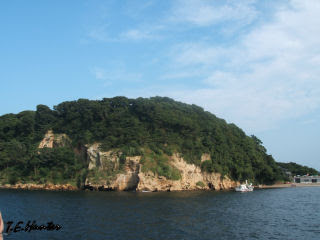
Being the idle monkey trainer, it seemed only fitting to visit Sarushima (Monkey Island)(pictured above). Monkey Island is the only remaining natural island in Tokyo Bay. It is located only a few minutes by boat from Yokosuka Naval Base, the forward deployment spot for the U.S. Navy's USS George Washington.
Visiting on the day the George Washington -- a nuclear powered vessel -- arrived in port, meant that a protest was inevitable. Being a Thursday, however, may have dampened participation. Or people really don't care. In either case, there were only seven elderly protesters at the station.
Bypassing the protest, we indulged in a couple of local beers - Sarushima, Yokosuka, and Admaarali (named for Admiral Togo), whose flagship from the Ruso-Japan war in 1905-6 did some serious damage to the Russian's Baltic fleet.


It was then off to Monkey Island. The island was used over various centuries as a fort and gun battalion, defending the bay up through the Meiji era. Remnants of the fort still remain on the island. Monkeys, however, do not reside there.
Upon realization of this fact, I was left to ponder why it was called Monkey Island. So with no information presenting itself, I developed a couple of theories about why there were no monkeys. These of course were based solely on the idea that the name Monkey Island implied the presence of monkeys, at least at the time the island was named. If that was true, then the monkeys had been wiped out by something. I formed two theories:
1. The monkeys were eaten into extension by the numerous kites that hover above the island. This theory, however, supposes that the kites hunt monkeys and there was no evidence to support that.
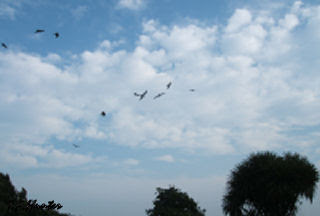
The kites witnessed on Thursday showed more scavenger tendencies. Therefore, theory two came into being:2. The soldiers posted on the island ate the monkeys into extinction. Again, there was no evidence that the soldiers ever ate monkeys.
Neither theory, however, was nearly as interesting as the real source of the name Monkey Island. The real story runs thus:
A boat of Buddhist monks were traveling in the bay by small boat. A massive storm came up and threatened to swamp the boat. A white monkey appeared before the monks and beckoned them to the safety of the island where the monks could ride out the storm. (White, in Japanese folklore, is often representative of ghosts or spirits. Why a monkey, however, is not really clear.)
Friday, September 19, 2008
Global Tito Update
And if that seems like a morbid route to follow, keep in mind this is Japan and you can always make it cute. For example, you can always collect all 47 Hello Kitty Ronin (conveniently available just outside the Sengaku Temple entrance.)
Monday, September 15, 2008
The Last Festival of the Season
This particular festival had a limited number of participants, and a fortunately smaller mikoshi than during previous experiences. This was fortunate in that the Idle Monkey Trainer stands several inches (centimeters) taller than most people in this country. The result was a Sweaty Monkey Trainer, with a sore shoulder. Nonetheless, it was an enjoyable evening.It was just a good thing the festival did not last too long.
Saturday, August 02, 2008
An Idle Thought
Saturday, July 26, 2008
The American Pastime, in a Japanese Style
The Idle Monkey Trainer, after several years of living in Japan, finally made it out to "the old ball game". Like anything borrowed from another culture, adjustments to local norms is likely. In the IT industry, this is referred to as "localization". And baseball is no exception. The Japanese have localized it.I had read and heard about the differences from others. But, for a while I have wanted to experience it first hand. So, last weekend I made my way to Yokohama Stadium to see the Yokohama Baystars take on the Tokyo Giants. (I see no point in going to a dome for a baseball game; the point of baseball to me has always been to sit in the sun and drink beer.)
The differences were apparent before the game even started. The first difference was presented to us when we reserved the tickets. A friend of the Idle Monkey Trainer made the reservations for tickets through a friend's husband who works for the organization. He apologized for the current bottom-of-the-league ranking of the Baystars. We were also asked which team we supported so that are seats would be in the right place. Fans are divided to keep tempers in check and the fists from flying. About half the stadium was full of Giants fans. Arriving just after 2:00 for a 2:30 first pitch, our party was greeted by the classic strains of "Take me out to the ball game". The song is not repeated in the 7th inning stretch. There were also more cheerleaders and costumed characters -- the black pig at the left is the mascot of the Tokyo Broadcasting System, owner of the Yokohama Baystars -- running around the field than I have ever seen at a U.S. game. The fans keep up an almost constant cheering and singing, in turn with their teams' respective at-bats. There are also specific songs/cheers that rise up after each run is scored. The Baystar's song ends in three cheers of "Bonzai"!
The game itself does not show much difference, in terms of rules or play anyway. The only obvious difference being that when a pitcher hits a batter, the pitcher will tip his hat in apology. I am more accustomed to the U.S. style of staring the guy down. Interestingly enough, on this afternoon, both pitchers were from the U.S.. Williams, starting for the Giants and lasting 2 2/3 innings, only tipped his hat to the first of the two batters he hit.In the end, the Baystars won 4 - 1 over the Giants (who are, by the way, the NY Yankees of Japan - with every negative -- and perhaps positive -- connotation that conveys).
Monday, July 14, 2008
Taiko Sushi
1500 yen, built for twoSaturday, July 12, 2008
Free Bird
Saturday, July 05, 2008
Star search
Besides Tanabata celebrations, more than 70,000 Japanese shops, offices and tourist attractions such as Tokyo Tower will take part in a "lights off" campaign to save energy on Monday evening.Tanabata is based on a Chinese legend, in which Kengyuu (the star Alter) meets Orihime (the star Vega) only once a year on this day over the Milky Way. People celebrate this day by putting up big branches of bamboo with colourful decorations at home. People also make a wish and hang a strip of paper with their wish written on it. (from nihongomemo.com)
"The G8 summit will take place on Tanabata, so we are working towards turning off the lights, and gazing at the milky way while re-affirming the importance of the environment," said Prime Minister Yasuo Fukuda in a speech last month.
Having lived in Tokyo for several years, I cannot help but think that the effort will not result in a view of the Milky Way. There is so much light pollution here, that only on the clearest nights and after the
lights at the nearby temple have been turned off, have I seen more than two stars at any one time. And one of those could have been a planet. The G8 leaders, at their relatively remote retreat, may indeed be able to see stars in the night sky.
Saturday, June 21, 2008
Global Tito Update
The orange lights are the shrines.Surrounding the main event, of course, are the attendant booths, selling food, booze and those with games. Games like "scoop the goldfish/turtle/other aquatic creature". Well, that is not the official name, but that better conveys the gist of it.
Scoop them up and take them home, as many as you can before your paper scooper disintegrates.
The catch of the idle monkey trainer, who, by the way, practices catch and release. After all, what is an idle monkey trainer going to do with six small green turtles and that other thing?


