Once again, the idle monkey trainer got out for the fun and exercise of trying to carry a two ton portable shrine through the narrow streets of Asakusa. (Full disclosure, the mikoshi above was the smaller and more comfortable of the two carried that day.) And somehow among all the photographs taken of a Westerner in matsuri clothing, the idle monkey trainer managed to get the photograph below.
Monday, May 18, 2009
三社祭 2009 Sanja Matsuri
Once again, the idle monkey trainer got out for the fun and exercise of trying to carry a two ton portable shrine through the narrow streets of Asakusa. (Full disclosure, the mikoshi above was the smaller and more comfortable of the two carried that day.) And somehow among all the photographs taken of a Westerner in matsuri clothing, the idle monkey trainer managed to get the photograph below.
Thursday, May 14, 2009
This just in...

Triumph model Hiromi Nishiuchi poses in a "konkatsu" (husband-hunting) bra in Tokyo on Wednesday. The bra sports a clock that allows the wearer to set an engagement date. Unless an engagement ring is inserted into the ring holder, the clock will count down to the appointed date and set off the alarm. Konkatsu has become a buzzword for women seeking security amid these recessionary times. The bra is not for sale. YOSHIAKI MIURA PHOTO
Tuesday, May 05, 2009
TSHA at the Korea Cup 2009


Sunday, May 03, 2009
I went to North Korea


Thursday, April 09, 2009
Back in time - sort of
Even at that point the city held close to a million people, about half of whom were samurai-class, in rather tight quarters. The above is a the typical room of a married couple (minus one wall). Volunteer guides are eager to escort visitors around the museum floor, offering a bit of history and quizzing visitors. Incidentally, during the explanation of this house, the answer to the guide's question about where they kept their underwear is not, "They didn't wear any?"
The museum comes complete with canal and boat (a main form of public transport on what was already "reclaimed" land.*) And, this being spring in Japan, nowhere is complete without blooming cherry trees.
Those interested in seeing a bit of the way Edo was, will find the musuem a short walk from Kiyosumi-shirakawa station on the Oedo and Hanzomon subway lines. Admission is 300 yen for adults.
Also just a couple minutes from the station is Kiyosumi Teien (Garden). The garden is full of large stones, providing pathways through the shallower portions of the pond and allowing up close encounters with what appear to be well-nourished but still very hungry koi (carp).
As with any pond or garden in Japan, there are also plenty of turtles, some balancing.
There is also an open space away from the pond which has an enourmous cherry tree and memorial for the Japanese poet Basho, with one of his poems carved in a large stone. "The sound of a frog, jumping into an old pond."
In many ways it is quite typical of Japanese gardens, but offers a nice retreat from the constant concrete buzz of modern Tokyo for 150 yen admission.
Tuesday, March 31, 2009
Sakura Blossoms and Booze
Spring has arrived in Japan, and although it is a little early for the sakura blossoms, the parks are filling with people getting drunk under the trees.
Thursday, March 26, 2009
Enoshima, Kanagawa
On Enoshima, an island sitting only about an hour south of central Tokyo, there is a set of caves containing various carvings of Buddhist statues. Access to the caves is obtained by either walking over the island or by taking a boat from the causeway. The boat costs 400 yen per person. Walking is free, unless you opt for the escalators to the top, which run 750 yen for use of all three, and to reach the caves you still need to walk down the other side.
The approach and entrance to the caves have obviously seen some fairly recent renovation, with a wide concrete bridge arcing around the cliff faces and keeping visitors safely above the rocky flats (and more interesting things). Along the cliff wall the old access path is still visible (though crumbling) and looked a lot more fun. Once inside, vertical fish tanks (sans fish, but the first sporting a little blue plastic dolphin) line a tunnel to the main cave. There are also some historic photos of some early tourists to the site adorning the walls.
The 500 yen entrance fee includes the use of a thin candle lamp, the necessity of which the idle monkey trainer failed to see. The main cave itself is relatively well lighted. Plexiglas separates the statues and the lighting from the visitors. The ceilings are low, and covered with one of three things: wire caging to keep rocks from falling on people, Plexiglas to keep water from falling on people, or foam padding to keep people off the roof. All are secured with large, exposed bolts, so caution is necessary. A good deal of the time you are in the caves will be spent in a hunched position if you are over four-feet tall, more if you’re over six-feet tall. The cave system is not very extensive, however, so it is not a long time.
The second cave is even more disappointing. In its farthest reaches is a plastic-looking dragon (safely in a fenced area), surrounded by black lights and phosphorous rocks. Despite the natural occurrence of phosphorous rocks in the area, the bright colors of these rocks appear false.
The tidal pools that can be accessed along the rocky and wind-swept coast near the cave entrance turned out to be largely devoid of life apart from some plants. I did spot one, very small, dead crab. (There was more live sea life seen at the sushi shop during dinner than witnessed while on the island.) Still, the few merchants along the route sell (or perhaps rent) small nets for kids to use in trying to capture anything they might find. There were a few intrepid youngsters giving it a try, but not seeming to have much luck.
Wednesday, March 18, 2009
Friday, March 13, 2009
Views of Hakuba, Japan


Wednesday, March 11, 2009
Mall rats
The economic downturn in the global economy has spawned reports of doom and economic malaise across the world. The Japanese press is no exception, with near daily reports of on the troubles of the major exporters of consumer products from cars (who would have ever believed Toyota would face trouble) to electronics.
The Japanese consumer has never been the driving economic force that the U.S. consumer is (was). Still, the reports of malls going under in America (I have heard one commentator speak of “ghost malls”) has not spread to Japan. If the Idle Monkey Trainer’s Sunday afternoon visit to the newish Koshigaya Lake Town Mall, a scant hour’s train ride from central Tokyo, is any indication Japanese malls are booming.
The mall sprawls across a couple of kilometers (and takes nearly 25 minutes for Japanese television reporters to walk across) and is divided into two sections called Wind and Forest (there was no forest anywhere to be seen). It has somehow gained a reputation for being cheap. Personally, I am not so sure. The mall is packed with the usual retailers that are found in Tokyo’s other shopping districts, with no real discernible difference in price, at least as far as I could tell.
In some ways, however, it had distinct advantages. The most prominent, to the Idle Monkey Trainer anyway, was the space. Despite the number of people, the mall does not feel overly crowded, though there were still lines of 30-plus minutes at KrispyKreme and Cold Stone Creamery – just as you’d expect in Shinjuku.
Tuesday, January 27, 2009


Not all the shrines have a statue of the god to be found. The first, however, does have a tall statue of the happiness god, waiting in a cave (as the sign informs) for one to rub his belly for luck. My own belly, not as developed, is probably not as lucky.


Friday, January 23, 2009
Tournament Hockey

On the past Sunday, January 18th, the Tokyo Street Hockey Association (TSHA) took to the surface in Tokyo to compete in a showcase tournament ahead of the start of a ball hockey league. Despite play that ranged from poor to mediocre and only scoring a total of three goals in four regulation games, TSHA managed a 2nd place finish. It took six shooters in a shootout for TSHA to advance over the Ushida Tigers. The team representing the Japan Street and Ball Hockey Federation (JSBHF) took first in a sudden death overtime. You can read the full account of the day on the TSHA website.
Thursday, January 22, 2009
Learning Japanese
It's difficult to provide adequate stimulation through manual masturbation.
Saturday, January 10, 2009
Nikko, Japan

The town of Nikko lies about a two-hour train ride north of Tokyo in the hills of Tochigi prefecture. Famous for its temples and shrines, Nikko is also well known for monkeys. So, on a clear January 3rd, the idle monkey trainer ventured forth to experience the town.
The main attraction of Nikko is a rare clustering of temples and shrines, called Tosho-gu. The complex is the final resting place for the Tokugawa Ieyasu (died 1617). Now a World Heritage Site, the complex stands out among Japanese temples and shrines for a couple of reasons. The first is the proximity of Buddhist temples and Shinto shrines. The second is the bright coloration of the buildings. In contrast to many temples and shrines in Japan, those at Tosho-gu are brilliantly adorned with gold, as well as the more traditional red.

Along the walls and eves are also numerous intricate carvings of animals and people. Perhaps the most famous of which are the three monkeys covering their eyes, ears and mouth to symbolize the Buddhist doctrine of “see no evil, hear no evil, speak no evil” (see photo at top) and the sleeping cats. The latter are reputed to be near life-like due to their intricacy (and require an additional 530 yen to view).
Up the mountain from Nikko are the Koggen Falls and the Nikko National Park. The falls take a spectacular drop from a lake, and are reputed to have drawn forlorn and unrequited lovers to make a final leap for centuries. Once source has it that more people jump here than from San Francisco’s Golden Gate Bridge. Other sources have said that the national police each winter take advantage of the freezing of the falls to dive the pool at the base and remove the summer’s leapers. Sadly, it gets dark in Japan very early in winter, and when the idle monkey trainer arrived at the falls it was well past dark. Only the faintest ghost of the falls could be seen in the cold light of the crescent moon.
The only other let-down of the day was that Nikko’s famed monkeys were nowhere to be seen. And so, the idle monkey trainer remained idle.
Wednesday, December 31, 2008
Happy New Year
Saturday, November 22, 2008
We are the champions -- of Kariya
Sunday, October 26, 2008
The 2008 Yamato Cup

The inaugural Yamato Cup was held October 11, 2008 at Amazing Square in Tokyo. Determination of who would win the coveted Golden Godzilla game down the the final seconds, when the final shot hit the post as time expired. In the end, Team Korea rallied from a 2-0 deficit to defeat the Tokyo Street Hockey Association (TSHA) 6-5. The final game was hard fought by both teams, and those in the arena were treated to fast-paced, back-and-forth ball hockey.
In the challenge for third place, and the slightly less-coveted Silver Gamera, the MHL Misconduct defeated the Boring Sponge with an impressive performance by the fast-passing, talented team. Tied at the end of the first half, the Misconduct opened up the game in the second half and cruised to victory.
Full details of this year's tournament can be found at www.yamatocup.com/2008. Information on how to be involved in next year's tournament can be found at www.yamatocup.com/2009.
Saturday, October 18, 2008
German Beer and Sausages

For two weeks, crowds of people, mostly Japanese, cram into long tables to eat German sausages and drink (expensive) German beer, all while polka bands, clad in lederhosen play. (In what would seem to be a break from true German tradition, however, there was also plenty of Japanese edamame, fried noodles and fried chicken.)
The final day was no exception, as the weather was perfect for an afternoon of drinking.

Friday, September 26, 2008
猿島 - Monkey Island

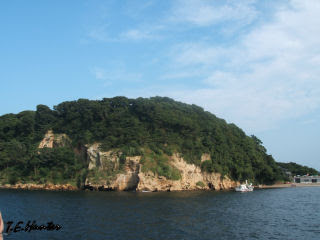
Being the idle monkey trainer, it seemed only fitting to visit Sarushima (Monkey Island)(pictured above). Monkey Island is the only remaining natural island in Tokyo Bay. It is located only a few minutes by boat from Yokosuka Naval Base, the forward deployment spot for the U.S. Navy's USS George Washington.
Visiting on the day the George Washington -- a nuclear powered vessel -- arrived in port, meant that a protest was inevitable. Being a Thursday, however, may have dampened participation. Or people really don't care. In either case, there were only seven elderly protesters at the station.
Bypassing the protest, we indulged in a couple of local beers - Sarushima, Yokosuka, and Admaarali (named for Admiral Togo), whose flagship from the Ruso-Japan war in 1905-6 did some serious damage to the Russian's Baltic fleet.


It was then off to Monkey Island. The island was used over various centuries as a fort and gun battalion, defending the bay up through the Meiji era. Remnants of the fort still remain on the island. Monkeys, however, do not reside there.
Upon realization of this fact, I was left to ponder why it was called Monkey Island. So with no information presenting itself, I developed a couple of theories about why there were no monkeys. These of course were based solely on the idea that the name Monkey Island implied the presence of monkeys, at least at the time the island was named. If that was true, then the monkeys had been wiped out by something. I formed two theories:
1. The monkeys were eaten into extension by the numerous kites that hover above the island. This theory, however, supposes that the kites hunt monkeys and there was no evidence to support that.
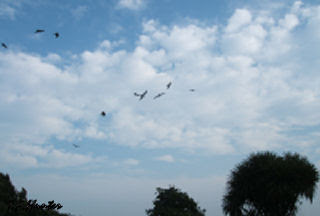
The kites witnessed on Thursday showed more scavenger tendencies. Therefore, theory two came into being:2. The soldiers posted on the island ate the monkeys into extinction. Again, there was no evidence that the soldiers ever ate monkeys.
Neither theory, however, was nearly as interesting as the real source of the name Monkey Island. The real story runs thus:
A boat of Buddhist monks were traveling in the bay by small boat. A massive storm came up and threatened to swamp the boat. A white monkey appeared before the monks and beckoned them to the safety of the island where the monks could ride out the storm. (White, in Japanese folklore, is often representative of ghosts or spirits. Why a monkey, however, is not really clear.)
Friday, September 19, 2008
Global Tito Update
And if that seems like a morbid route to follow, keep in mind this is Japan and you can always make it cute. For example, you can always collect all 47 Hello Kitty Ronin (conveniently available just outside the Sengaku Temple entrance.)


